

KUVEX/
Initializing
Autonomous Engineering OS
0%
Autonomous Engineering OS · v2.6
ships.
Oronis coordinates planning, implementation, design, testing, and review from one goal. Your workspace stays local while managed intelligence handles the reasoning required for each task.
No cloud IDE. No per‑task prompting. Describe the goal — Oronis analyzes it, plans rigorously, and assigns exactly the agents the work needs.
Oronis parses intent, scans the codebase, and scores the risk — a real plan before a single file moves.
It routes each subtask to the right specialist — and skips the ones that don't apply. The crew is built per request.
The assigned agents implement, self‑heal, and pass every check before the PR opens — CI green.
 orchestratoridle
click the diagram to route a different request →
Scroll the product, page by page. Fourteen surfaces that share one live state — here are the eight you’ll live in.
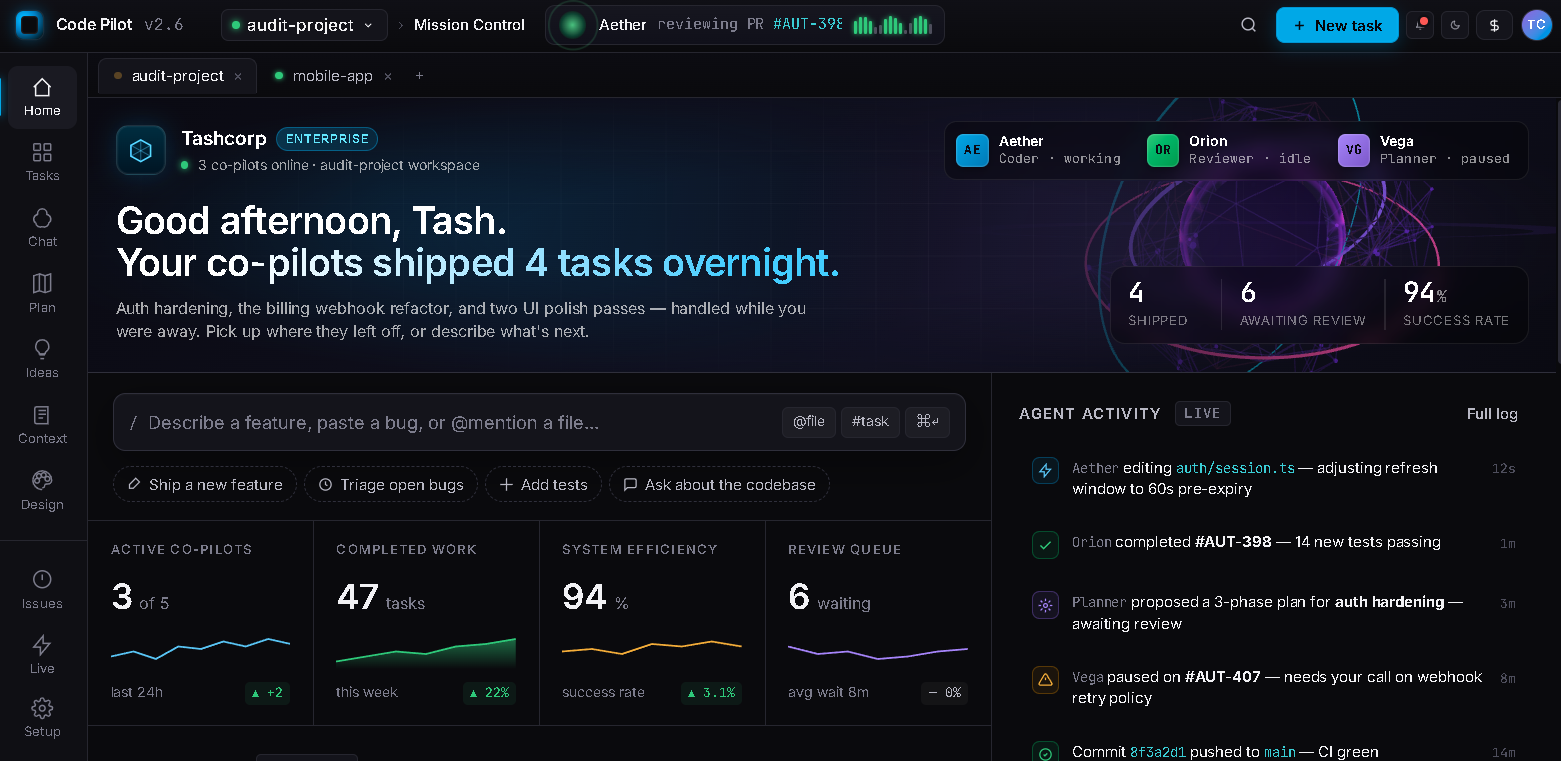
Mission Control is the first thing you see — live KPIs, the agent activity stream, and a digest of everything that shipped while you were away. Pick up where the work left off.
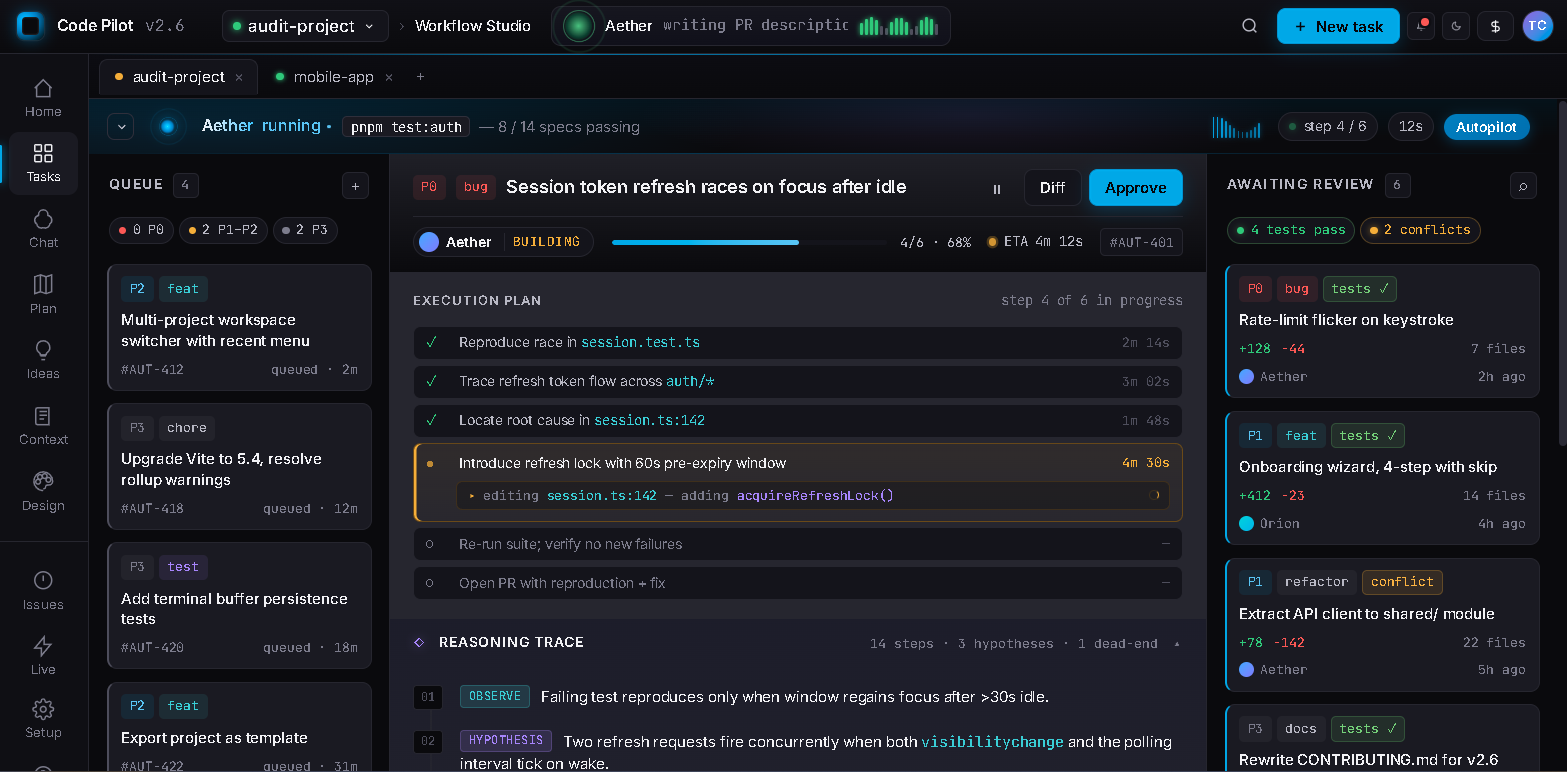
Workflow Studio shows the execution plan, the reasoning trace, and the live test stream as agents work. Approve the diff yourself, or hand it to autopilot.
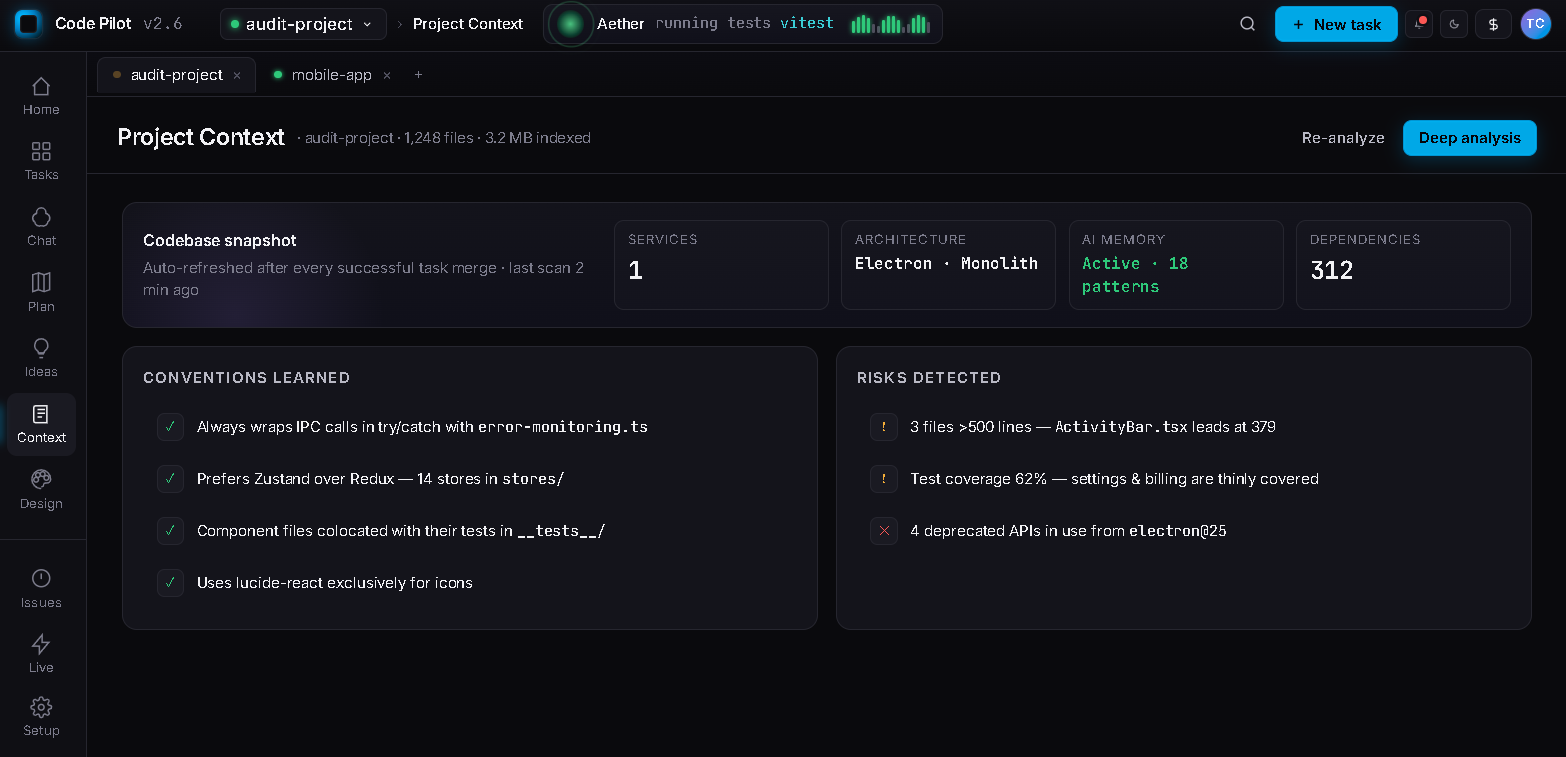
Intelligence Hub reads the relevant files and answers in plain language — grounded in real citations, code excerpts, and the exact symbols it referenced.
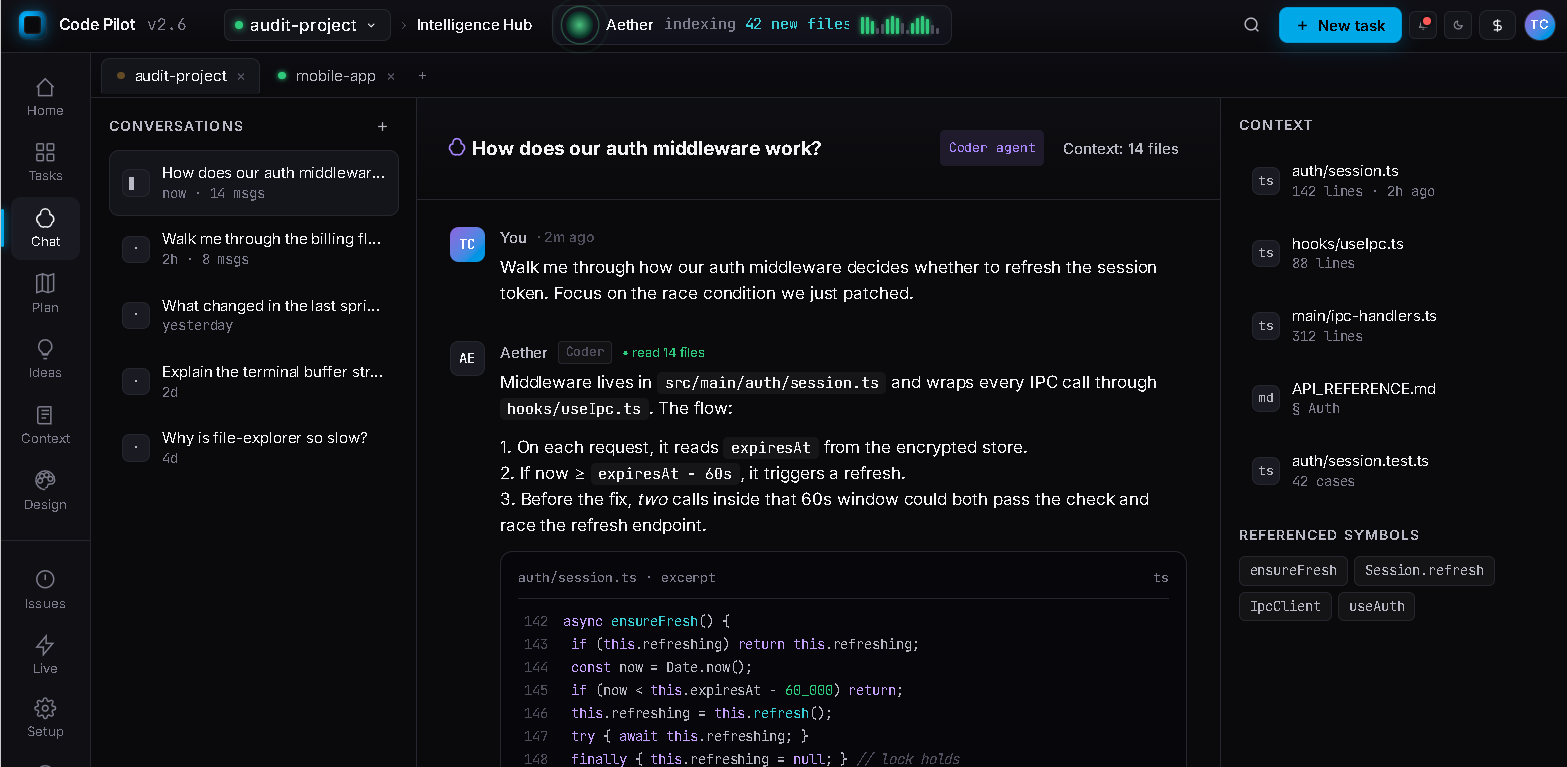
Strategic Planner lays out phases, milestones, and progress against your target — and generates the next phase on demand when you’re ready to move.
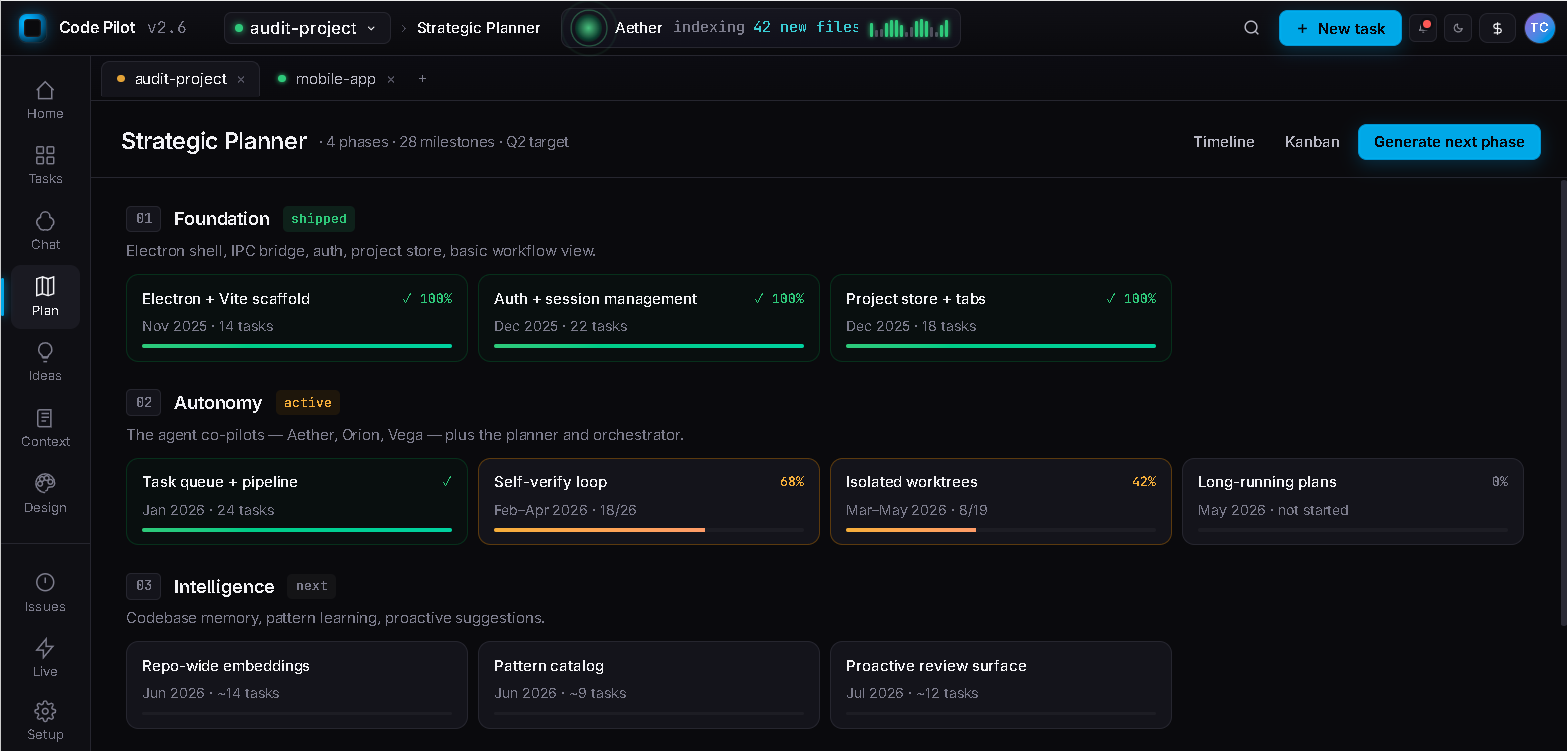
Concept Lab surfaces ranked ideas across performance, security, UX, and code quality — each scored by impact, each one click away from becoming a task.
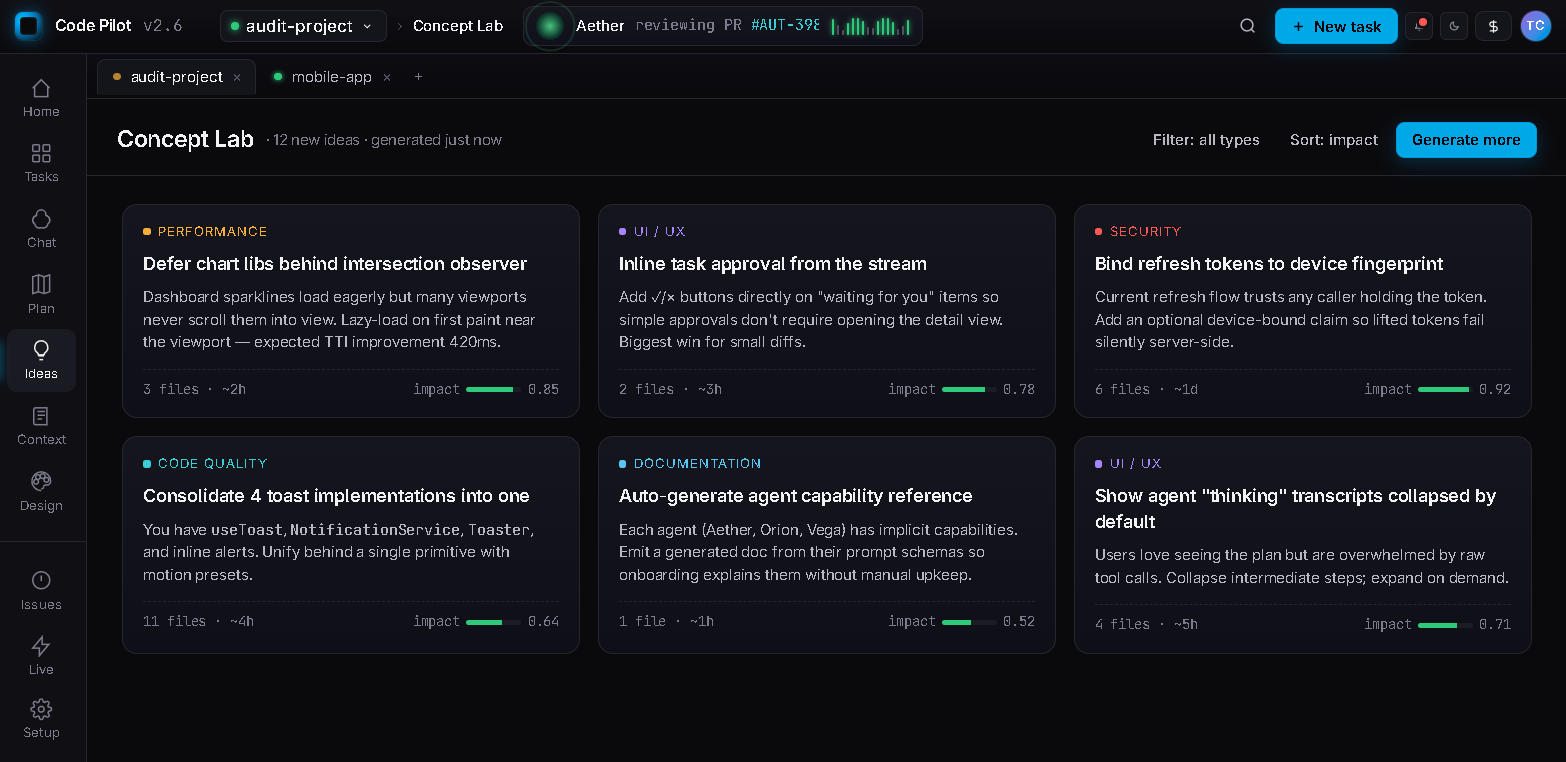
Project Context is the living model of your codebase — conventions learned, risks detected, dependencies and patterns — re-analyzed after every successful merge.
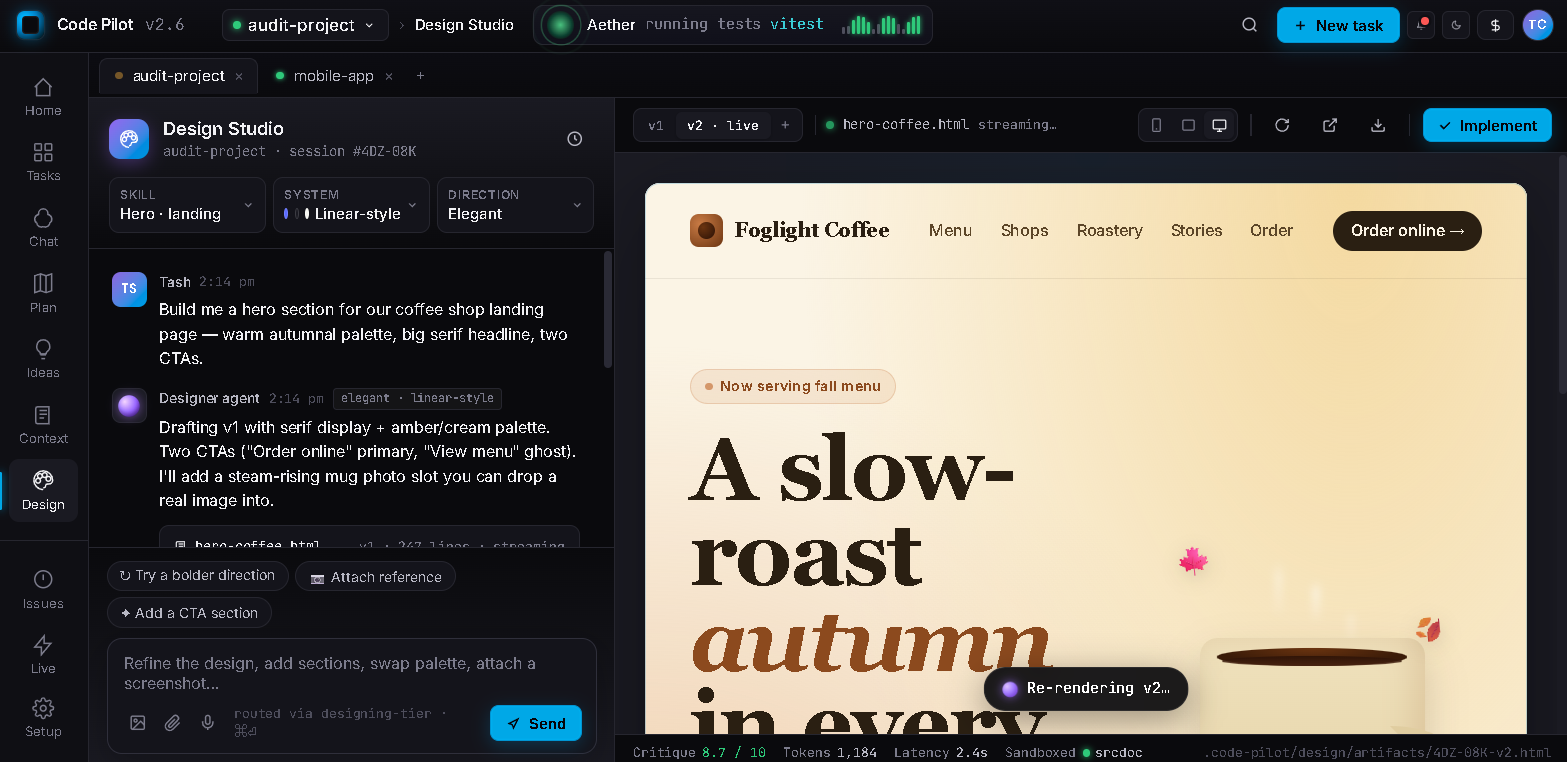
Design Studio turns a prompt into UI and renders it live in a sandbox — iterate across versions, drop in real images, and ship it with one click.
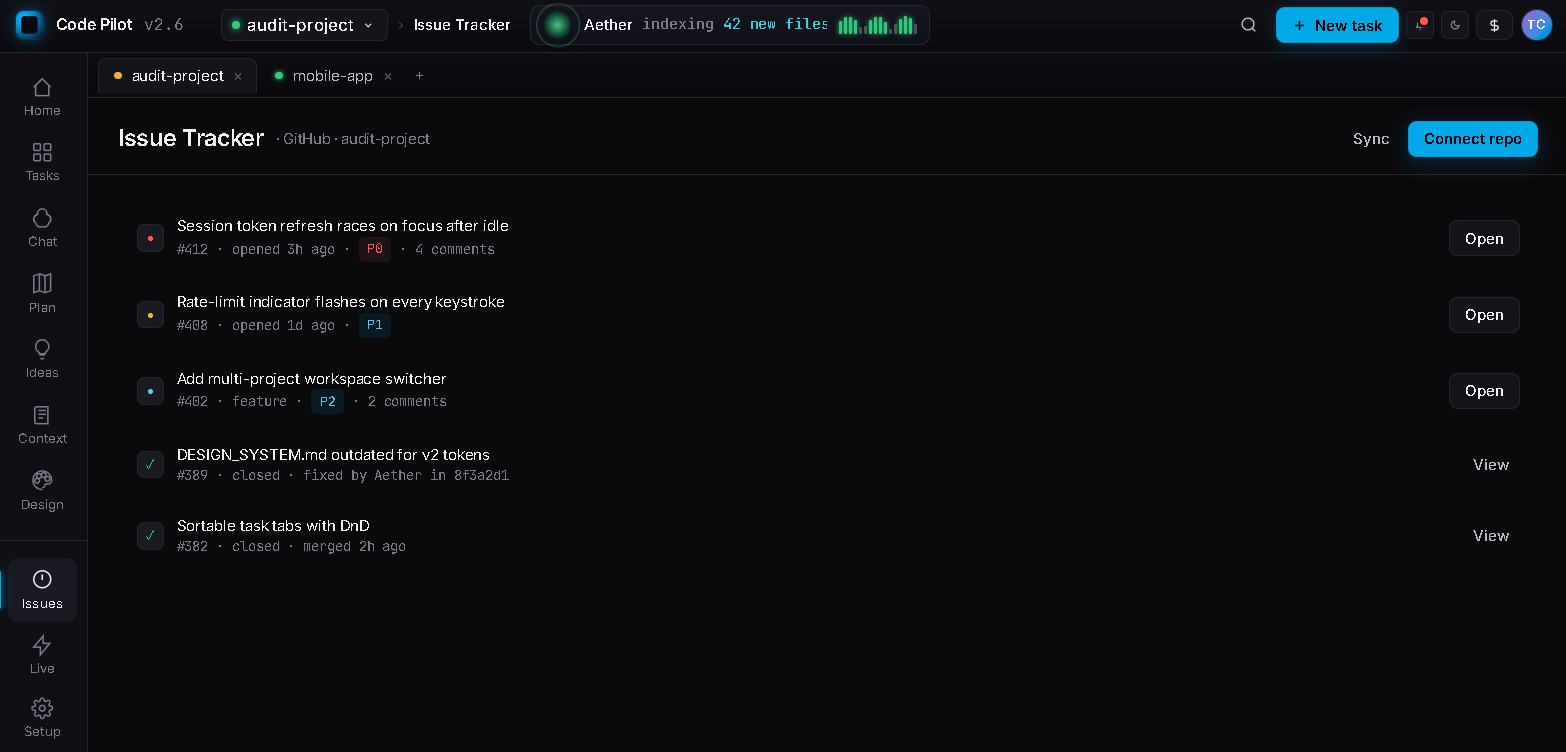
Issue Tracker syncs your repo, triages what’s open, and lets agents close issues end-to-end — fixed, merged, and linked back to the task that did it.
No fixed crew. Oronis reads each request and pulls in only the specialists the work demands — and the roster grows with every skill you add.
Oronis reads every request, analyzes the codebase, scores the risk, and writes the plan. Then it assembles the crew — assigning the specialists the work needs, skipping the ones it doesn't, and self‑healing up to 50 iterations before it ever asks for help. Nothing runs on a fixed pipeline.
Breaks the request into subtasks, identifies file targets, and writes the spec. Architecture before code.
APIs, handlers, data models, migrations. Edits files in place and runs them against the suite.
Components, state, styling, accessibility — wired to a live preview as it goes.
pytest, vitest, and playwright with coverage gates — auto‑triggered the moment a build completes.
bandit, OWASP‑aligned scans, secret detection, and lint. The PR opens only when it's clean.
Every skill file you add teaches a new specialist. There's no fixed set — the crew expands to fit the work.
No cloud IDE and no mirrored repository. Oronis works through the files on your machine and sends only the task context required for managed AI processing.
Your repository remains on your computer. Oronis reads and changes files through the local runtime instead of copying the project into a cloud IDE.
Oronis selects and routes the appropriate intelligence internally. You do not need separate model subscriptions or provider keys.
Only the instructions and relevant task context needed to generate a response are sent for managed AI processing.
A local activity log of every action an agent takes — inspectable, exportable, and fully yours.
Every plan gets the same engine and the same quality. Plans differ in how many agents run at once, queue priority and support. Worktree isolation, review before merge, checkpoints and undo, and the full activity log are in every plan, never an upsell. Prices exclude applicable tax.
Most "AI coding" tools autocomplete inside your editor — you still drive every step. Oronis owns the whole loop.
Straight answers on how your code, your data, and the agents actually work.
Your working files stay local. Oronis runs on your hardware and reads and writes to the files on your disk. It only reaches an external code host when you link a GitHub repository — at which point it reads and pushes to that repo using a token you control. Until you connect one, nothing about your project is committed or mirrored anywhere.
Oronis routes each task through KUVEX-managed AI infrastructure behind the scenes. You never select or manage individual models. The instruction and relevant context needed for a task are sent for processing under the applicable provider terms, while your working repository remains on your machine. Subscription pricing includes this managed usage.
Every request is handled by a crew assembled on demand. A planner decomposes the goal, coders implement it, a reviewer inspects the diff, and a tester runs the suite — with security and other specialists pulled in only when the work calls for them. You describe the outcome; Oronis decides which agents the task needs.
Only after you connect a GitHub repository with a token you provide. Agents work on an isolated worktree, run the full test suite, and open a clean PR for your review — they never force‑push or merge without you. No repo linked means no external code access.
Oronis reads your codebase — conventions, patterns, dependencies — and adapts to it rather than forcing a fixed pipeline. It builds backend, frontend, tests, and migrations across whatever languages and frameworks your repository already uses.
Oronis is launching soon. Paid plans start at $29/mo (Solo), with Pro at $79, Ultimate at $149 and Team at $79 per seat; annual billing saves 20%. Launch access includes a bounded reverse trial: 7 days or 10 tasks on trial access, then choose Solo, Pro, Ultimate or Team to continue. Paid subscriptions are non‑refundable once the software has been used — see our Refund Policy.
Oronis is a subscription that covers real AI‑provider usage on every request. Because that cost is incurred the moment you start working, our billing terms are deliberately straightforward.
Dissatisfaction, technical problems after use, partial use, unused days or forgetting to cancel do not make a used payment refundable. EU/UK customers consent at checkout to immediate supply of the service and acknowledge that the withdrawal right ends once it starts doing work for them. Refund requests: billing@kuvex.ai. Nothing here limits non‑waivable statutory rights.
Your working files stay on your machine. To generate a response, the context a task needs is sent through KUVEX-managed AI infrastructure and handled under the applicable data-processing terms. Code reaches GitHub only when you link a repository.
Read the privacy policy →The agreement that governs your use of Oronis — your account, acceptable use, the agents’ access to your repositories, and billing through Paddle as Merchant of Record.
Read the terms →Payments and tax are handled by Paddle. For billing questions or an eligible refund request, reach us directly — we respond within 1–2 business days.
billing@kuvex.ai →Oronis is launching soon. Drop your email and we’ll send the reverse-trial invite the moment access opens.
Once the official walkthrough is published, add its YouTube or Vimeo URL in portal-config.js and this modal will play it here.
Pre-sales questions, technical issues, billing — reach the right inbox below and a human will get back to you quickly.
Our official community will open with the product launch. Join the email list for verified access and launch news.
We collect only what we need to run Oronis, we never sell your personal data, and we never use your code to train AI models.
To operate the service (authentication, subscription access), process payments via Paddle, send transactional emails, diagnose bugs, prevent fraud, and meet legal obligations. Product-update emails are optional and you can opt out anytime.
You can request access, correction, deletion, or a portable copy of your data, and object to processing — email privacy@kuvex.ai and we respond within 30 days. Account data is deleted within 30 days of a deletion request; billing records are kept 7 years for compliance; AI prompts are not retained beyond the request; usage logs are anonymized after 90 days.
All data is encrypted in transit over HTTPS, passwords are stored as bcrypt hashes, and payment data never touches our servers. The service is not directed to anyone under 18. Data may be processed internationally by our providers under appropriate safeguards. Questions: privacy@kuvex.ai. The full policy lives at oronis.kuvex.ai/privacy.html.
By creating an account or using Oronis, you agree to these Terms. You must be at least 18 and have authority to accept them.
Oronis, by KUVEX Private Limited (India), is an autonomous AI software-engineering desktop app, currently for Windows, that plans, writes, tests, and ships code on your behalf. We may modify or discontinue parts of the service with reasonable notice where practicable.
Oronis is a monthly or annual subscription that renews automatically until cancelled. Annual billing is one upfront payment at a 20% discount. Paid plans have no task caps; each plan sets how many tasks run at once, under our Fair Use Policy. Payments, tax, and invoicing are handled by Paddle as Merchant of Record; prices exclude applicable taxes. Cancelling stops future charges at the end of the paid period; we give at least 30 days' notice of any price change.
A payment is final from the first request the Oronis app sends to our service after the charge, including if technical problems appear after use. It is refundable in full within 14 days only if no request at all has been recorded since that charge, for first payments and renewals alike. See the Refund Policy for full details.
Don't use Oronis to break the law, build malware, reverse-engineer or resell the service, overload our infrastructure, use it outside the Fair Use Policy, or infringe others' rights. Violations may end your account without notice or refund.
The service is provided "as is" without warranties. To the maximum extent permitted by law, KUVEX's total liability is capped at the amount you paid in the preceding three months, and we're not liable for indirect or consequential damages. These Terms are governed by the laws of India; please contact legal@kuvex.ai to resolve disputes informally first. Full terms: oronis.kuvex.ai/terms.html.
You can try Oronis free before paying. Once you pay, the payment is final from the first request the Oronis app sends to our service. If you have not used it at all since a payment, you can have that payment back within 14 days.
The trial runs for 7 days or 10 completed tasks, whichever comes first. It needs no payment details and never becomes a paid plan on its own. There is no permanent free tier.
A payment is refundable in full only if you ask within 14 days of the charge and not a single request has been recorded under your subscription since it: no task, chat message, plan, review or other AI request, even one that failed, by anyone on the subscription. Signing in or browsing is not a request for work. This applies to first payments and renewals.
The Oronis service records every piece of work it processes, with the account and time. We check those records from the moment of the charge and tell you the result within 2 business days. Approved refunds are submitted to Paddle and returned to your original payment method.
Cancel anytime online, from your account or the link in any Paddle receipt; the plan runs to the end of the paid period with no further charges. EU/UK customers consent at checkout to immediate supply and acknowledge that the withdrawal right ends once the service starts doing work for them. Nothing here limits non-waivable statutory rights.
Email billing@kuvex.ai from your account email with your Paddle order number. Full policy: oronis.kuvex.ai/refund.html.
